Showing posts with label Engaged spirituality. Show all posts

Wednesday, July 08, 2015

Prayer and the Power of Politics


During the week I was on my seven day silent retreat, several pivotal world events occurred: the Supreme Court decisions preserving the Affordable Care Act and the legalization of same-sex marriage; the coordinated bombings in France, Tunisia and Kuwait; Pres. Obama’s eulogy for Rev. Clementa Pinckney, and the burning of seven African-American churches in South Carolina. Given that I had set aside this time to pray and reflect, I gave these events a dedicated time each day for prayer. However, the issue that consumed most of my attention then and still now was and is the budget negotiations in Harrisburg regarding the proposed increase in funding for public education (which the Democrats and governor proposed and to date the Republicans have opposed).

I was specifically focused on this issue because I knew that while I was at the Retreat Center, fifteen folks had dedicated themselves to fast and maintain a presence on the Capitol steps for the ten days from June 20 to June 30 promoting the adoption of a fully funded formula for public education in Pennsylvania. A few months earlier, I had been part of a group that had developed the idea of a 100 day “Fast for Family Values” across the state, and then worked on the idea of a “Moral Takeover” in Harrisburg focused on a 10 day fast in the final days of the budget negotiations. I had joined about 150 others on June 20 initiating the fast, as we anointed the Capitol doors and laid hands literally and figuratively on the “Harrisburg 15” who would maintain a constant presence on the Capitol steps. During the ten days various groups came each day to support the fasters, but because of my prior commitment to the retreat, I was not among them.

Having been part of the planning up to that point, I was upset and troubled that I was not able to be to support them. As an alternative, I dedicated myself to pray for the fasters and for the negotiations each day. On the retreat grounds was a labyrinth. I didn’t know much about the tradition of praying a labyrinth, nor had I ever done it before in any sort of serious way. The labyrinth is a sort of maze on the ground, which is a tool for prayer and meditation used by many religious traditions. As one author says: “Walking the labyrinth is a way of praying with the body that invites the divine presence into an active conversation with the heart and soul. By engaging in this walking meditation, we are fully engaging our minds, bodies, and spirits at the same time.” On a few evenings I walked the labyrinth thinking of the budget negotiations and praying the words from the Lord’s Prayer: “Thy Kingdom, thy will be done, on earth as it is in heaven.” What struck me was that just as the labyrinth was circuitous route from the outside of the circle to the center, so too the ways of God usually do not
follow a straight path and often surprise us when our prayers are answered.

At other times I physically pointed my body in the direction of Harrisburg, even holding out my hands, seeking to reach out to the Capitol with longing and intention. In the morning and again at evening I read the latest news on the negotiations and added that information to my prayers. On a few occasions, I broke my internet silence enough to shoot off a brief email to my legislators, one of whom is the chair of the House Appropriations Committee and therefore a key player in the ongoing budget discussions. All in all I felt at one with the fasters and others advocating and protesting at the Capitol even though I was over 50 miles away.

All of this got me thinking about the power of prayer and the power of politics. Given the choice between joining in a protest or a march versus praying, I would always choose the former, so praying at a distance was different place for me. However, the more I prayed the more emboldened and hopeful I became, and I came to believe that however circuitous the route, justice for the school children of the state and of Philadelphia in particular would prevail. How I didn’t know, but it would prevail.

In their book Faith-Rooted Organizing authors Peter Heltzel and Alexia Salvatierra write “In faith-rooted organizing, we believe we can answer the question, ‘How do we want the world to be different because of our efforts?’ by casting a common vision rooted in God’s vision” (p. 29). Drawing from the examples of Martin Luther King, Jr., Cesar Chavez, liberation theologians and others who rooted their protest in their faith, these authors challenge people of faith to use the tools of faith and their inherent trust in the God of justice to work for positive social change. Those of us involved in the fight for educational justice had done just that in calling for a fast, anointing the Capitol doors, laying hands on the faster and maintaining a prophetic presence. From afar, I was doing the same thing with my labyrinth walks and prayers toward the Capitol. In so doing I felt I was engaging the issue not just at the level of politics, but at the level of what the apostle Paul called “the principalities and powers” (Romans 8) undergirding the political system.

On one level, one might say, “Who are you kidding? Political power will win every time over praying.” Yet I don’t know. I remember Cory Aquino and the People Power Revolution in the Philippines when in 1986 masses of people marching and praying peacefully brought down the dictatorship of Ferdinand Marcos. I have read of Cesar Chavez’s fast for farmworker justice. I have read of the powerful transformation that took place in South Africa with the Truth and Reconciliation Commission. Maybe prayer and spiritual power is more than we, at least I, think it is. As I write this, there has been no dramatic change in state funding for education, yet for the first time in a long time, I have begun to feel that the sacrificial power of prayer could win the day, and persistent work backed and accompanying prayer might just prove to be too much for legislators to ignore. We can only wait and see, and of course, pray.

[Pictures by the Author; Labyrinth from Google Images looked very much like the labyrinth I walked]

Tuesday, July 07, 2015

Ignatius (and Augustine) in the City


As I indicated in my previous posting, I recently participated in a seven day silent retreat at the Jesuit Retreat Center in Wernersville, PA. After the first four days I was floundering, feeling bored and a bit stressed about the whole experience. However on the fifth day, things turned around.

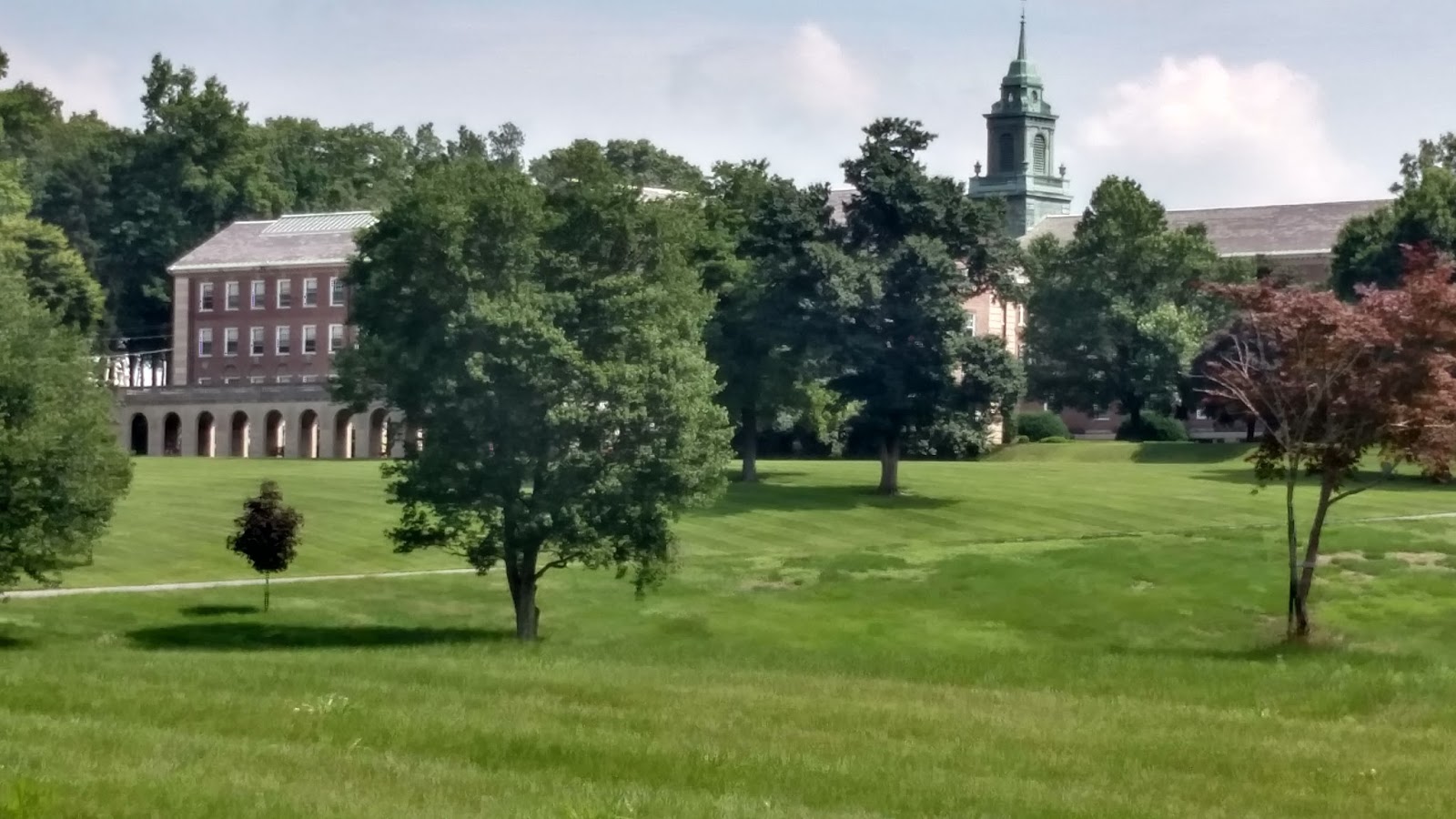
The retreat center is located on a hill overlooking a  valley tucked between two ridges and encompasses over 250 acres of verdant fields, numerous trees, and a variety of walking paths with shrines and benches on which to sit, read, meditate, pray, sleep or however the Spirit leads. Each day of the retreat I met with a spiritual director who gave me a series of instructions based on the Spiritual Exercises of St. Ignatius, a regimen the founder of the Jesuits created to develop the spiritual life of the priests in the order. For many people this setting would have been idyllic, but for me it began to feel confining.

Several years ago I began practicing what I have come to call engaged spirituality . The focus of engaged spirituality is not to withdraw from normal life to meet God, but instead to immerse oneself in it. As I wrote in July 2010 I came to realize that “God was not far off only to be experienced in some mystical transcendence, God was among us to be touched and experienced in the busyness of life.” So I decided to take my retreat off campus and into the city of Reading (pronounced “Redding”) ten miles away.

On that morning, Bruce, my spiritual director, instructed me to use a particular approach to reading Scripture developed by Ignatius in the 16th century in which the reader, using imagination, places him/herself in the Biblical story and seeks to see the story from the inside. As James Martin says in The Jesuit Guide to (Almost) Everything the purpose is to “[imagine] yourself in a scene in the Bible…and then take part in it” (p. 145). All four of the passages involved events in the early life of Jesus, and so were quite familiar to me. I drove to the Reading visitor’s center, got a map of the city and then parked my car on South 10th St.  near the South Reading Middle School, and began walking around the largely Mexican neighborhood. My adventure with Ignatius-style engaged spirituality began.

For the next four hours I followed a simple pattern. I would stop on the steps of a building and slowly read and think about the assigned passage. Then I would get up and walk for 20 minutes or so, taking in the sights, sounds, smells and feel of the neighborhood and then stop and write down my reflections and observations in a spiral notebook. Often I would sit and simply watch and listen to what was going on around me. In the spirit of the silent retreat, I did not speak to anyone unless they spoke to me. For instance I had a few panhandlers approach me and a couple times folks said something to me as they passed by. Other than that I simply observed and reflected what I saw.

I stopped on the steps of a church to read my first assigned Scripture of the day, which was the story of the birth Jesus in Luke 2. This is where the 4th century Christian philosopher Augustine showed up. Augustine, like Ignatius, developed a unique way of Bible reading. Augustine’s approach was to have the reader recast the story into his/her contemporary context. So as I read the first passage which was Luke’s account of the birth of Jesus in Bethlehem, I put myself in Mary and Joseph's shoes, but then I imagined what would this birth have looked like had it occurred  in this Reading neighborhood. In this neighborhood, where would one go if there "was no room" for a stranger to stay? Where would Mary and Joseph gone to give birth to their son? Would it be an alley somewhere or an abandoned house or the back of the car? I imagined that Mary and Joseph would have felt out of place in this strange town where the folks had a distinctly different accent from the folks in Nazareth.  As I reflected on these insights, this passage came alive to me in a new ways. I saw the vulnerability Mary and Joseph must have felt for their baby. I imagined myself holding this newborn child in this strange and vulnerable setting, and wondering, would he survive? What chance did he have? The idea that Jesus "shared our weakness" became very real as I imagined holding the Christ child on that Reading street.

As I walked the streets, I saw young mothers and fathers on the street with their little children. I thought of what it must have been like for Jesus. Perhaps some of these parents were undocumented in ways similar Mary, Joseph and Jesus, not fully accepted, yet struggling to survive. The young parents appeared to love their children, but  also knew their futures were difficult.  The kids were happy and playful, as were their parents, but if they were like Joseph, Mary and Jesus, underneath there probably was a great deal of confusion, fear and uncertainty.

I continued walking and paused on the steps of an old Methodist Church, a Spanish language Pentecostal church and a Habitat for Humanity project, I repeated the exercise with the other assigned Scriptures. I thought  of Jesus at age 12 years (Luke 2. 41-50) in a church somewhere talking to elders while his folks frantically searched all over Reading for three days looking for their missing child, who when he was found seemed non-plussed and unconcerned with his mother's question - "Why did you do this to us?" What confusion and terror the parents must have felt, wondering what was becoming of this boy, who seemed so sure of himself. As a parent I wondered about the elders who were talking to Jesus? Didn’t they wonder where the boy’s parents were? Where did Jesus eat and sleep the four days he was "missing?" Looking all over Reading only to find him a church? How frantic they must have been.

At another point I imagined John the Baptist baptizing Jesus (Matthew 3) by opening a fire hydrant on the street. As the water shot out in a long wide spray flooding the street, I could see in my mind’s eye children dancing and screeching with delight in the spray, while firefighters tried to close it off and shoo the people away. There in the midst of this chaos I saw Jesus come up to John and say “Let’s do this,” as John poured water on his head. And then “boom” everything stopped as a voice said “This is my Son, listen to him.”

The last Scripture of the day was the story of Jesus being tempted in the desert by Satan (Matthew 4). When Satan offered Jesus the power to turn stones into bread, I pondered what would the "stones" in Reading be like. It came to me that Jesus might recognize that some of the homeless folks, the addicts, the unemployed, and the lonely elderly I passed as I walked might feel as listless and useless as stones, and not like bread that could nourish others. Wouldn't Jesus instantly be tempted to give them meaning and a sense of their own value? But Jesus would know they were not stones,that in fact they were "bread" - they were people with purpose, inherent worth, meaning and power; they had simply forgotten, or perhaps never known, they had that kind of value. Jesus would not have to "change them " but rather would want to help them see their own beauty and inner strength, to see that they were not "stones" but nourishing "bread" for others. The second temptation - jumping off a high place - was easy to imagine and I could see Jesus scaling one of the many church spires while a crowd gathered on the street wondering if he would jump. In that neighborhood such a spectacle could have easily been something to talk about; but Jesus resisted the urge to be such a spectacle.

The third and final temptation (where Satan offers Jesus all the kingdoms of the world) required that I get in my car and drive up a large hill above the city overlooking the entire region for 20-30 miles. I imagined Satan offering Jesus power over all that he could see in exchange for paying homage to him instead of God. From on top of that hill I felt the emptiness of power corrupted by greed and self-centeredness, things we see nearly every day in corporate and political realms. I realized if Jesus had gone with Satan's ploy, his "power" would have been instantly corrupted and therefore made destructive. Imagining myself in the place of Jesus, I could sense that domination power would not significantly tempt him, a power that was "high and lifted up" designed to control people. Instead, I imagined Jesus would want to be back on the street and in the neighborhood with folks, sharing their struggles, hearing their stories, and being with them in their lives; leading by serving rather than by dominating, exercising his ability to help people see their inherent beauty and God-given power. In the end the Jesus I saw in Reading was not a typical power broker, but one who came to "dwell among us" as the gospel writer John so clearly reminds us.

As I drove back to the retreat center late that afternoon, I was spiritually energized in a way I had not been in a long time. By taking the Bible reading approaches of Ignatius and Augustine with me into the city, I saw Jesus among the good folks of Reading in a fresh and renewing way. I left the city that day with a deep sense of connection to the people there and the presence of Jesus among them. On that day through silent observation and active imagination I saw,heard and felt the presence of Jesus in a Reading  neighborhood in and around South 10th St.

Wednesday, January 29, 2014

Seeking Deeper Power


Just over five years ago on a very cold January afternoon I was arrested along with six others for blocking the entrance to Colisimo's gun shop on Spring Garden Street in Philadelphia. We were there to call attention to the store’s complicity in the straw purchasing process that leads to illegal guns getting into communities that are overwhelmingly used in street crimes. In the trial that ensued one of the things that I was always uneasy about is that in our defense, our lawyer stressed that we were praying in front of the store as part of our protest. While I understand that public prayer has been an effective from of political protest going back at least to the Civil Rights Movement, that it makes for good political theater, and that was an effective legal defense strategy, in my case it just was not true. Frankly I was too #%&@ cold to pray!

There were some deeply spiritual people among the twelve people who were arrested over the two days of civil disobedience protest: a young woman who later that year walked the El Camino in northern Spain; a Jewish Rabbi who is  a spiritual guide to many young Jews; a Quaker activist who on the street and in the jail regularly called us to pray. But not me. Now I did have a sense going in that I was living out the apostle Paul’s call to “present your bodies as a living sacrifice”(Roman 12.1). However, while I probably should have been praying, I wasn’t. In that moment of protest I was not calling on a deeper source of power to transform Mr. Colisimo’s heart; I was just trying to stay warm while sitting in front of his store. Moreover,  when I was arrested and spent a day and night in jail I did not call on and sense God’s presence in the jail cell; I wish I had because when I was left alone by myself in the cell I felt  totally cut off from people and God , so much so that I  nearly went crazy. Instead of meeting God that day, I experienced trauma and a spiritual emptiness that took months for me to process. (To see my reflections on the experience go to this link). So when my lawyer said I was praying in front of the store, I wish it were true, but I was not.

Five years later in a different way I find myself facing a similar challenge and question. I find myself in a spiritual state of unease while being involved in the faith-based network POWER (Philadelphians Organized for Witness, Empowerment and Rebuilding). Through POWER I am engaged  with many others in a campaign to convince the governor and legislature of Pennsylvania to develop a full and fair funding formula for resourcing the state’s public schools, particularly the Philadelphia School system. In our meetings we talk about developing and exercising power, by which we mean getting people out to vote and to rallies in sufficient numbers to convince politicians that we are force to be reckoned with. Most, if not all, of the people involved would consider themselves “people of faith” by which they mean that their values and worldviews are shaped by their faith tradition be it Jewish, Christian or Muslim. Our gatherings often begin with prayer and a faith reflection, and yet somehow I feel like we are missing something extremely important, a deeper power, the power of the Spirit that shapes and informs our various faith traditions.


Richard Rohr, a Franciscan priest and the co-founder of the Center for Action and Contemplation writes about the Perennial Tradition, a belief coming out of the Roman Catholic tradition that affirms that there is “a Divine Reality underneath and inherent in the world” that connects all the world’s faith traditions and from which each of  those traditions emerge. He compares this Divine Reality to an underground stream from which all faith traditions draw their strength and inspiration. Through the years there have been numerous efforts by Christian, Jewish, Muslim and Buddhist teachers to articulate and describe this deeper source of power that links all faith traditions, while at the same time honoring the uniqueness of each. Now for some this idea of a deeper power linking all spiritual traditions wades into troubling theological waters. For instance, in my Christian tradition we emphasize that Jesus is “the Way, the Truth and Life and no one comes to [God] except through [him]” (John 14.6).  I have come to see this statement as just another one of the paradoxes of my faith, such as the first shall be last, that in dying we find new life, that in suffering there is victory, and that blessing comes through suffering. In the same way Jesus is the Way while at the same time he points me to a deeper power linking to people of various faith traditions much different than my own.

How else do we account for some of the great leaders and spiritual teachers who come from different traditions. How do I as a Christian account for the power of Gandhi, the Dalai Lama, Thich Nhat Hahn, Aung San Suu Kyi, Malcom X, Abraham Joshua Heschel and Elie Wiesel? Yes I am inspired by Christian leaders like Martin Luther King, Jr., John Woolman and Thomas Merton, but I can not dismiss the power of these other voices from outside my tradition as well.

I am not what one would call a spiritual person. Yes, I worship and pray, but I don’t go through life with an ever-present awareness of God in my life. I have never heard God’s voice, or had a profound mystical experience. Even so I work at it, regularly reading the Bible and other spiritual readings. I even try to meditate. The great teachers say to do it right you should meditate at least for 20 minutes two times a day. I can barely manage 10 minutes once a day, if that; I feel better for it, but I am not expecting any great breakthroughs anytime soon.

On the other hand, some of my most profound spiritual experiences have occurred in very non-religious, non-spiritual settings, such as when I attended the 2010 U. S. Social Forum where 15,000 social activists (most of whom were decidedly secular) met to share ideas and strategize on ways to bring about social change or when I gathered with about 50 others for a vigil in Philadelphia’s Love Park to call attention to gun violence in our community, or when I am walking the streets of West Philadelphia watching and sensing the dynamic of the neighborhood. Somehow when I am out there in the community working for the change that is needed in concert with many others, that’s when I feel most aware of God’s presence.

I try to practice what I and others have called an engaged spirituality, an approach that seeks to meet Christ in the midst of the people in action. It is through engaged spirituality that I wish that groups like POWER and Heeding God’s Call (a faith based group working on gun violence prevention) would realize that our strength and power comes not just from being able to exercise our political muscle but also comes from that deeper source from which all our spiritual traditions issue. Gandhi and King talked about soul-force, which I take to mean a source of power that is more than simply the collective numbers of faith-oriented persons working on a particular issue. Heschel said that prayer by its very nature is subversive  and that it works to overthrow the powers of oppression and falsehood. How do we tap into the power that can topple the power structures of our day? That’s the question I grapple with.


As I sometimes have shared in this blog space, I have grown skeptical of the political process in our day largely because the politicians are beholden to the wealthy 1%, lobbyists and corporations who line their pockets in exchange for deference and favors. For example, when 80% of Americans polled after the Sandy Hook massacre think there ought to be stricter gun laws and the Congress can’t even pass a weak background check bill, it is pretty obvious the politicians are not listening to the people; they are following the money. So I am skeptical of using the tactics of people power, unless those people come with pockets full of cash. To defeat the powers that be we must draw not just on our political power, but also on that deeper power that unites us as people of faith. We need to find ways to pray corporately even as we act to bring down the rulers of our day, both political and financial, so that justice can roll down like waters, and righteousness like an overflowing stream of the Spirit (Amos 5.24.)