Showing posts with label Police Brutality. Show all posts

Tuesday, April 28, 2015

A Reason for Grief, A Reason for Hope


It was the best of times, it was the worst of times,
it was the age of wisdom, it was the age of foolishness,
it was the epoch of belief, it was the epoch of incredulity,
it was the season of Light, it was the season of Darkness,
it was the spring of hope, it was the winter of despair,

These opening words to Charles Dickens’ Tale of Two Cities capture my feelings as I read and watch the news from Baltimore.

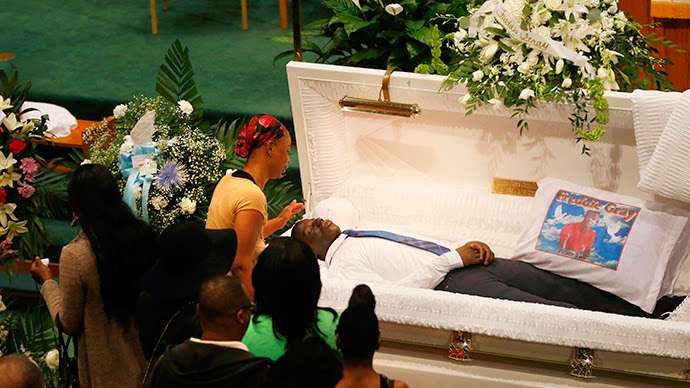
I woke up this morning to the front page news of riots last night in the aftermath of the Freddie Gray shooting and funeral. The news became more personal because my daughter works at Johns Hopkins University on the northern edge of Baltimore, and the school was closed in response to the violence. I have talked with friends and it seems like the events in Baltimore are more of the same: Trayvon Martin, Michael Brown, Eric Garner, Brandon Tate Brown, Tamir Rice and now Freddie Gray. Young Black men killed in confrontations with police.

A couple weeks ago in a course on social justice that I teach to first and second year college students, we read about the beating of Rodney King by Los Angeles police in 1992 and the riots that followed. None of those 18-20 year old students were alive at that time, and yet the issues were the same that arose  in Ferguson and are at issue in Baltimore: poverty, racial injustice, police brutality, frustration, anger and rioting. Then I thought of 24 years earlier in 1968 following the assassination of Dr. Martin Luther King and riots that erupted in cities across the country, and again the issues were the same.


As a nation we think we are making progress and for a time we do. Funding for schools is increased, job training is provided, and neighborhoods improve but then as a nation we lose our edge, our vigilance and our concern, and again the forces of inequity and injustice take over. Many scholars have indicated that the inequities we experience today have their roots in the economic and criminal justice policies adopted in the early 1980’s reducing taxes on the rich and corporations, decreasing the services and programs for the poor and targeting drug and criminal enforcement policies in low income communities of color. And so is it any wonder that every 20 years or so, people explode.

I am reminded of the questions raised by Langston Hughes in his classic poem , “A Dream Deferred:”

What happens to a dream deferred?
Does it dry up
like a raisin in the sun?
Or fester like a sore--
And then run?
Does it stink like rotten meat?
Or crust and sugar over--
like a syrupy sweet?

Maybe it just sags
like a heavy load.

Or does it explode?

At the same time I see this injustice, I am encouraged by the Black Lives Matter movement and other such groups of young people and young adults who have come together to call attention to a whole range of injustices in wages, school funding, police behavior, the right to unionize and so much more. I am encouraged that these groups have allied themselves with more seasoned groups to work 
together for common goals. I have tried to impress upon my students that they are living in historic times, that a social movement is emerging such as not been seen since the Civil Rights Movement of the 1950’s and `1960’s, a movement comprise of young and old, of rich and poor, of all races and ethnicities, of gay and straight, of documented and undocumented – all committed to a democracy that works for all and not the privileged few. It’s a movement fueled by anger and frustration, informed by complex social analysis, and facilitated by social media. Moreover, in my view it’s a movement that will not fade or go away but is growing, expanding, and in some places like Philadelphia is becoming a force that politicians and corporate leaders need to listen to. I suspect that is happening elsewhere as well.

So while I grieve the fact that another Black man has died an unnecessary death at the hands of police authorities, and it baffles me how law enforcement personnel don’t seem to be getting the message that these sorts of incidents will no longer go unnoticed, and I am saddened by the looting and violence that has occurred, I see a reason for hope. In a poem to former priest, Nicaraguan leader, and poet Ernesto Cardenal, Robert McAfee Brown wrote:

You have shown us
that beauty also dwells
in misery’s environs
and by its presence here
can work huge transformations

You have shown us
that there is nothing more beautiful
than a human face
on fire with the love of justice*


I pray that like Ernesto Cardenal, the tragic death of Freddie Gray and so many others can give us faces on fire with a thirst and love for justice that will not be quenched until transformation comes.


* poem by Robert McAfee Brown "To Ernesto: Poet/Revolutionary in Liberation Theology: an Introductory Guide

Pictures from Google Images


Thursday, February 12, 2015

Philly's Own Ferguson


Last night I attended a community meeting at Catalyst for Change Church in West Philadelphia entitled “Philadelphia After Ferguson: A Meeting to Discuss Policing, Politics and Perception”. An impressive group of leaders including representatives of several activist groups, an editor for the Philadelphia Daily News, and representatives of the SEPTA police and the Philadelphia police Department made up a panel that was supposed to engage one another and the crowd in a dialogue. However, it quickly became evident that the event should have been entitled, “Philadelphia’s Own Ferguson: The Case of Brandon Tate Brown.”

Brandon Tate Brown was a 26 year old Black man who was shot by a police officer in the head on Dec 15, 2014. The name of the officer involved has not yet been released nor a copy of a video that was taken of the incident. Brown’s mother, Tanya Brown Dickerson, spoke to the packed sanctuary of several hundred people about the death of her son, and described the ordeal she went through, even trying to find out what had happened to him. She told how throughout the night she called her son’s cell phone and did not learn of his death until it was reported on the news the next morning. She asked for information about the officer who killed her son and a copy of a videotape that was taken of the incident. 

Then the moderator and media personality Chris Norris, instructed the crowd that the proceedings would follow a question and answer format designed to encourage dialogue among the panelists and the gathered crowd. However, almost immediately a group of Tanya Dickerson’s supporters began demanding that Deputy Police Commissioner Kevin Bethel “release the tape” and the name of the officer. Bethel responded in bureaucratic-ese saying the “investigation was ongoing.” He apologized to Ms. Dickerson that her son’s death had not been reported directly to her by the police (instead of the morning news), but beyond that made no promises to meet her requests. This only enraged her supporters more, and what was supposed to be a “discussion” turned into a shouting match.

As the event continued, the embedded racism in both the conduct of the police and the media became clear. While the name of the officer is being protected by the police department and the police union, Brandon Tate’s name and past criminal record were in the news even before his mother knew he had been shot. While police officers are able to hide behind the “blue code’ where no one reports a corrupt officer, community members can be arrested for obstruction of justice if they don’t “snitch” on a neighbor who has committed a crime. Kelvyn Anderson, president of the Police Advisory Board, a community group supposedly established to review such incidents, has gotten no information and told how it took over a year to get a meeting with the Police Commissioner when he first was hired. Thus the anger and frustration of the mostly Black crowd was palpable and understandable.

Yet I also don’t think much of anything productive was accomplished. There was a lot more shouting than listening, with members of the Brown advocacy group shouting over panelists even when they agreed with them. Moreover, the organizers of the event either were unable or unwilling to rein in the proceedings and abide by the very ground rules they had set. Rev. Mark Tyler, pastor of Mother Bethel AME and a leader in POWER, at one point compared the event to the SRC meetings where people come and vent and nothing changes. People who supposedly were in support of each other’s positions were interrupting and shouting over one another. After nearly two hours, the pastor of Catalyst for Change, called the meeting to a close, and surprisingly everyone abided by his call for a moment of silence in memory of victims like Brandon Tate Brown, Michael Brown, Eric Garner and others. Then the meeting ended and I doubt anyone went home any wiser or feeling heard or satisfied.

While the process was supposed to be a question and answer dialogue, I was struck by how few people actually knew how to ask good questions. Most of the questions asked were rhetorical; that is, they were statements disguised as questions, and even when someone tried to address a question, there was no willingness to hear anything other than the answer the questioner wanted, which in most cases  were details about the Brandon Tate Brown case the police were not willing to release. As a result, instead of engendering greater understanding, the proceedings hardened people’s positions and raised defensiveness and distrust.

As one of the few White people in the room who was not a reporter or a police officer, I listened and watched. I sat next to a young East Asian man from the neighborhood, who at one point asked me if I thought he should try to speak; I rolled my eyes with a “good luck.” Several others tried to get a chance at the mike  and also went unheard.The few who were able to speak pointed out that the local community had a responsibility as well, and that depending on politicians to address all problems was shirking their own responsibility. Thus, I think there were far more perspectives present than the few that made themselves heard, and that was unfortunate.


I have thought and written a lot about what it means to be a White ally in recent years, and as I sat there last night, I wondered what it meant to be a White ally in that context. In that contentious setting my role as an ally was very unclear. The injustice is real, and the anger, frustration, grief and fear many Black people hold in many neighborhoods are understandable and real. As one of the police officers on the panel acknowledged, while violent crime has gone down over the last several years, mistrust of the police has sky-rocketed. Last night that mistrust  was evident, and to be honest I don’t know how they can get it back if “Philadelphia After Ferguson” is any indication.

[Pictures taken by the author; and Philly.com)