Thursday, August 06, 2015

One Year Later

What happens to a dream deferred?
Does it dry up
like a raisin in the sun?
Or fester like a sore –
And then run?
Does it stink like rotten meat?
Or crust and sugar over –
like a syrupy sweet?

Maybe it just sags
like a heavy load.

Or does it explode?
(Langston Hughes)

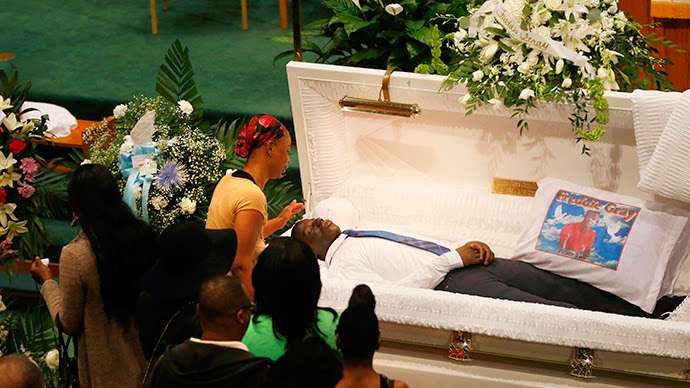
On August 9 the nation will remember the one year anniversary of the shooting death of Michael Brown by Officer Darrin Wilson in Ferguson, Missouri. When the event occurred I was vacationing with my wife in Maine, and the shooting did not make the evening news. Yet within a day, the nation and the world began to learn of a stirring taking place in Ferguson in a way that shook Black people to their painful soulful core, and led to an eruption that has continued to smolder. There were peaceful marches, overshadowed (in the media) by angry looting, and police dressed in combat gear reinforced by the National Guard. From the politicians and police there was a call for order and but from the communities of color around the country there was a call for justice. Officer Wilson was not charged, but that cry was not silenced and the call for justice continued to grow. 


Pretty soon, we were hearing other names like Tamir Rice (Cleveland), Eric Garner (NYC), Brandon Tate Brown (Philadelphia) and Freddie Gray (Baltimore). And there was Charleston and the Black churches burned in its aftermath. Just this past month Sandra Bland (Texas) and Samuel Debose (Cincinnati) were added to that list. There were a few retaliatory reactions such as the murder of NYC police officers Wenjian Liu and Rafael Ramos, and tensions between members of the Black communities and police departments in communities across the nation grew tense to the brink of breaking. And the movement that has come to be called “Black Lives Matter” emerged and continues to grow.


For many White folks this eruption of anger and frustration came as a surprise. We  Whites hadn’t been paying attention. We had seen glimpses like the riots after Rodney King’s beating and the marches after the death of Trayvon Martin, but then things slipped out of our view and we got lulled back to sleep. We thought that Michael Brown’s shooting was somehow unique, out of the ordinary, and a deviation from a racially peaceful norm, even though it was all too normal for Black and Latino men in this country. We didn’t understand the reactions of anger, frustration, despair and even hate, but that was  normal too in communities of color. Back in the ’90’s Cornel West had written of nihilism in many poor communities of color. In the 1980’s Peggy McIntosh had written about the “invisible knapsack” of White male privilege. If given a chance to tell their story, almost every person of color I have known personally has shared a story of being stopped, frisked, and harassed just for “driving while Black.” No this wasn’t new. What was new was that the anger got coordinated and organized, and reached what Malcolm Gladwell calls the “tipping point.”

I wrote recently of my sense that we are in a Kairos moment, a coming together of folks and forces that portend a shift in the tectonic plates of history. When these kinds of seismic shifts take place, it is unpredictable, frightening and chaotic. As I look back over the year since Michael Brown’s tragic death, I don’t recall a year of such social dynamism, since I was young person watching the Civil Rights and anti-war movement unfold in the 1960’s. People look back to the '60's with a nostalgic longing for the passion and the fervor, but we have forgotten how divisive, strident and unsettling life was then too. Just like now, folks in the '60’s didn’t know where would end up but they knew things needed to change; so too now.

One year from the events in Ferguson, we are no closer to really engaging the issue of institutional racism in our criminal justice system and our society in general. A lot of important leaders from the President on down have said some significant things, but the patterns of violence, degradation and exclusion have not changed. Far too many Whites deny they have any role or responsibility for addressing the deep cancer of racism built into our culture and societal structures. Others think it either useless or hopeless.  However, the Pew Research Center recently reported that there has been a significant spike in the last five years of Americans (43% to 59%) who think there is a significant problem with racism in this country. While among Whites that percentage is only 44%, it is much higher (17%) than only five years ago. Perhaps we Whites are slowly starting to wake up that America’s original sin cannot be ignored. Whether we get on board or not, the movement for change has begun.


I close by inviting you to listen to another Langston Hughes poem, “The Kids Who Die,” recited by Danny Glover and set with images from past and present. Written in 1938 in the height of Jim Crow, this poem has a haunting relevance. May we hear and not turn away. May we walk in Mike Brown’s memory, people of all races, ethnicities and creeds with our “hands up” toward that dream that has been deferred far, far too long.


Wednesday, July 08, 2015

Prayer and the Power of Politics


During the week I was on my seven day silent retreat, several pivotal world events occurred: the Supreme Court decisions preserving the Affordable Care Act and the legalization of same-sex marriage; the coordinated bombings in France, Tunisia and Kuwait; Pres. Obama’s eulogy for Rev. Clementa Pinckney, and the burning of seven African-American churches in South Carolina. Given that I had set aside this time to pray and reflect, I gave these events a dedicated time each day for prayer. However, the issue that consumed most of my attention then and still now was and is the budget negotiations in Harrisburg regarding the proposed increase in funding for public education (which the Democrats and governor proposed and to date the Republicans have opposed).

I was specifically focused on this issue because I knew that while I was at the Retreat Center, fifteen folks had dedicated themselves to fast and maintain a presence on the Capitol steps for the ten days from June 20 to June 30 promoting the adoption of a fully funded formula for public education in Pennsylvania. A few months earlier, I had been part of a group that had developed the idea of a 100 day “Fast for Family Values” across the state, and then worked on the idea of a “Moral Takeover” in Harrisburg focused on a 10 day fast in the final days of the budget negotiations. I had joined about 150 others on June 20 initiating the fast, as we anointed the Capitol doors and laid hands literally and figuratively on the “Harrisburg 15” who would maintain a constant presence on the Capitol steps. During the ten days various groups came each day to support the fasters, but because of my prior commitment to the retreat, I was not among them.

Having been part of the planning up to that point, I was upset and troubled that I was not able to be to support them. As an alternative, I dedicated myself to pray for the fasters and for the negotiations each day. On the retreat grounds was a labyrinth. I didn’t know much about the tradition of praying a labyrinth, nor had I ever done it before in any sort of serious way. The labyrinth is a sort of maze on the ground, which is a tool for prayer and meditation used by many religious traditions. As one author says: “Walking the labyrinth is a way of praying with the body that invites the divine presence into an active conversation with the heart and soul. By engaging in this walking meditation, we are fully engaging our minds, bodies, and spirits at the same time.” On a few evenings I walked the labyrinth thinking of the budget negotiations and praying the words from the Lord’s Prayer: “Thy Kingdom, thy will be done, on earth as it is in heaven.” What struck me was that just as the labyrinth was circuitous route from the outside of the circle to the center, so too the ways of God usually do not
follow a straight path and often surprise us when our prayers are answered.

At other times I physically pointed my body in the direction of Harrisburg, even holding out my hands, seeking to reach out to the Capitol with longing and intention. In the morning and again at evening I read the latest news on the negotiations and added that information to my prayers. On a few occasions, I broke my internet silence enough to shoot off a brief email to my legislators, one of whom is the chair of the House Appropriations Committee and therefore a key player in the ongoing budget discussions. All in all I felt at one with the fasters and others advocating and protesting at the Capitol even though I was over 50 miles away.

All of this got me thinking about the power of prayer and the power of politics. Given the choice between joining in a protest or a march versus praying, I would always choose the former, so praying at a distance was different place for me. However, the more I prayed the more emboldened and hopeful I became, and I came to believe that however circuitous the route, justice for the school children of the state and of Philadelphia in particular would prevail. How I didn’t know, but it would prevail.

In their book Faith-Rooted Organizing authors Peter Heltzel and Alexia Salvatierra write “In faith-rooted organizing, we believe we can answer the question, ‘How do we want the world to be different because of our efforts?’ by casting a common vision rooted in God’s vision” (p. 29). Drawing from the examples of Martin Luther King, Jr., Cesar Chavez, liberation theologians and others who rooted their protest in their faith, these authors challenge people of faith to use the tools of faith and their inherent trust in the God of justice to work for positive social change. Those of us involved in the fight for educational justice had done just that in calling for a fast, anointing the Capitol doors, laying hands on the faster and maintaining a prophetic presence. From afar, I was doing the same thing with my labyrinth walks and prayers toward the Capitol. In so doing I felt I was engaging the issue not just at the level of politics, but at the level of what the apostle Paul called “the principalities and powers” (Romans 8) undergirding the political system.

On one level, one might say, “Who are you kidding? Political power will win every time over praying.” Yet I don’t know. I remember Cory Aquino and the People Power Revolution in the Philippines when in 1986 masses of people marching and praying peacefully brought down the dictatorship of Ferdinand Marcos. I have read of Cesar Chavez’s fast for farmworker justice. I have read of the powerful transformation that took place in South Africa with the Truth and Reconciliation Commission. Maybe prayer and spiritual power is more than we, at least I, think it is. As I write this, there has been no dramatic change in state funding for education, yet for the first time in a long time, I have begun to feel that the sacrificial power of prayer could win the day, and persistent work backed and accompanying prayer might just prove to be too much for legislators to ignore. We can only wait and see, and of course, pray.

[Pictures by the Author; Labyrinth from Google Images looked very much like the labyrinth I walked]

Tuesday, July 07, 2015

Ignatius (and Augustine) in the City


As I indicated in my previous posting, I recently participated in a seven day silent retreat at the Jesuit Retreat Center in Wernersville, PA. After the first four days I was floundering, feeling bored and a bit stressed about the whole experience. However on the fifth day, things turned around.

The retreat center is located on a hill overlooking a  valley tucked between two ridges and encompasses over 250 acres of verdant fields, numerous trees, and a variety of walking paths with shrines and benches on which to sit, read, meditate, pray, sleep or however the Spirit leads. Each day of the retreat I met with a spiritual director who gave me a series of instructions based on the Spiritual Exercises of St. Ignatius, a regimen the founder of the Jesuits created to develop the spiritual life of the priests in the order. For many people this setting would have been idyllic, but for me it began to feel confining.

Several years ago I began practicing what I have come to call engaged spirituality . The focus of engaged spirituality is not to withdraw from normal life to meet God, but instead to immerse oneself in it. As I wrote in July 2010 I came to realize that “God was not far off only to be experienced in some mystical transcendence, God was among us to be touched and experienced in the busyness of life.” So I decided to take my retreat off campus and into the city of Reading (pronounced “Redding”) ten miles away.

On that morning, Bruce, my spiritual director, instructed me to use a particular approach to reading Scripture developed by Ignatius in the 16th century in which the reader, using imagination, places him/herself in the Biblical story and seeks to see the story from the inside. As James Martin says in The Jesuit Guide to (Almost) Everything the purpose is to “[imagine] yourself in a scene in the Bible…and then take part in it” (p. 145). All four of the passages involved events in the early life of Jesus, and so were quite familiar to me. I drove to the Reading visitor’s center, got a map of the city and then parked my car on South 10th St.  near the South Reading Middle School, and began walking around the largely Mexican neighborhood. My adventure with Ignatius-style engaged spirituality began.

For the next four hours I followed a simple pattern. I would stop on the steps of a building and slowly read and think about the assigned passage. Then I would get up and walk for 20 minutes or so, taking in the sights, sounds, smells and feel of the neighborhood and then stop and write down my reflections and observations in a spiral notebook. Often I would sit and simply watch and listen to what was going on around me. In the spirit of the silent retreat, I did not speak to anyone unless they spoke to me. For instance I had a few panhandlers approach me and a couple times folks said something to me as they passed by. Other than that I simply observed and reflected what I saw.

I stopped on the steps of a church to read my first assigned Scripture of the day, which was the story of the birth Jesus in Luke 2. This is where the 4th century Christian philosopher Augustine showed up. Augustine, like Ignatius, developed a unique way of Bible reading. Augustine’s approach was to have the reader recast the story into his/her contemporary context. So as I read the first passage which was Luke’s account of the birth of Jesus in Bethlehem, I put myself in Mary and Joseph's shoes, but then I imagined what would this birth have looked like had it occurred  in this Reading neighborhood. In this neighborhood, where would one go if there "was no room" for a stranger to stay? Where would Mary and Joseph gone to give birth to their son? Would it be an alley somewhere or an abandoned house or the back of the car? I imagined that Mary and Joseph would have felt out of place in this strange town where the folks had a distinctly different accent from the folks in Nazareth.  As I reflected on these insights, this passage came alive to me in a new ways. I saw the vulnerability Mary and Joseph must have felt for their baby. I imagined myself holding this newborn child in this strange and vulnerable setting, and wondering, would he survive? What chance did he have? The idea that Jesus "shared our weakness" became very real as I imagined holding the Christ child on that Reading street.

As I walked the streets, I saw young mothers and fathers on the street with their little children. I thought of what it must have been like for Jesus. Perhaps some of these parents were undocumented in ways similar Mary, Joseph and Jesus, not fully accepted, yet struggling to survive. The young parents appeared to love their children, but  also knew their futures were difficult.  The kids were happy and playful, as were their parents, but if they were like Joseph, Mary and Jesus, underneath there probably was a great deal of confusion, fear and uncertainty.

I continued walking and paused on the steps of an old Methodist Church, a Spanish language Pentecostal church and a Habitat for Humanity project, I repeated the exercise with the other assigned Scriptures. I thought  of Jesus at age 12 years (Luke 2. 41-50) in a church somewhere talking to elders while his folks frantically searched all over Reading for three days looking for their missing child, who when he was found seemed non-plussed and unconcerned with his mother's question - "Why did you do this to us?" What confusion and terror the parents must have felt, wondering what was becoming of this boy, who seemed so sure of himself. As a parent I wondered about the elders who were talking to Jesus? Didn’t they wonder where the boy’s parents were? Where did Jesus eat and sleep the four days he was "missing?" Looking all over Reading only to find him a church? How frantic they must have been.

At another point I imagined John the Baptist baptizing Jesus (Matthew 3) by opening a fire hydrant on the street. As the water shot out in a long wide spray flooding the street, I could see in my mind’s eye children dancing and screeching with delight in the spray, while firefighters tried to close it off and shoo the people away. There in the midst of this chaos I saw Jesus come up to John and say “Let’s do this,” as John poured water on his head. And then “boom” everything stopped as a voice said “This is my Son, listen to him.”

The last Scripture of the day was the story of Jesus being tempted in the desert by Satan (Matthew 4). When Satan offered Jesus the power to turn stones into bread, I pondered what would the "stones" in Reading be like. It came to me that Jesus might recognize that some of the homeless folks, the addicts, the unemployed, and the lonely elderly I passed as I walked might feel as listless and useless as stones, and not like bread that could nourish others. Wouldn't Jesus instantly be tempted to give them meaning and a sense of their own value? But Jesus would know they were not stones,that in fact they were "bread" - they were people with purpose, inherent worth, meaning and power; they had simply forgotten, or perhaps never known, they had that kind of value. Jesus would not have to "change them " but rather would want to help them see their own beauty and inner strength, to see that they were not "stones" but nourishing "bread" for others. The second temptation - jumping off a high place - was easy to imagine and I could see Jesus scaling one of the many church spires while a crowd gathered on the street wondering if he would jump. In that neighborhood such a spectacle could have easily been something to talk about; but Jesus resisted the urge to be such a spectacle.

The third and final temptation (where Satan offers Jesus all the kingdoms of the world) required that I get in my car and drive up a large hill above the city overlooking the entire region for 20-30 miles. I imagined Satan offering Jesus power over all that he could see in exchange for paying homage to him instead of God. From on top of that hill I felt the emptiness of power corrupted by greed and self-centeredness, things we see nearly every day in corporate and political realms. I realized if Jesus had gone with Satan's ploy, his "power" would have been instantly corrupted and therefore made destructive. Imagining myself in the place of Jesus, I could sense that domination power would not significantly tempt him, a power that was "high and lifted up" designed to control people. Instead, I imagined Jesus would want to be back on the street and in the neighborhood with folks, sharing their struggles, hearing their stories, and being with them in their lives; leading by serving rather than by dominating, exercising his ability to help people see their inherent beauty and God-given power. In the end the Jesus I saw in Reading was not a typical power broker, but one who came to "dwell among us" as the gospel writer John so clearly reminds us.

As I drove back to the retreat center late that afternoon, I was spiritually energized in a way I had not been in a long time. By taking the Bible reading approaches of Ignatius and Augustine with me into the city, I saw Jesus among the good folks of Reading in a fresh and renewing way. I left the city that day with a deep sense of connection to the people there and the presence of Jesus among them. On that day through silent observation and active imagination I saw,heard and felt the presence of Jesus in a Reading  neighborhood in and around South 10th St.

Saturday, July 04, 2015

Seven Days of Silence


I am not what people would refer to the “strong, silent type.” Yet for seven days from June 25 – to July 1 I participated in a silent retreat conducted by the Jesuit Center in Wernersville, PA. Last fall I volunteered to be part of a study being conducted by Dr. Andrew Newberg of Jefferson Hospital in Philadelphia who is doing research on the relationship between spiritual practices and brain function. Dr. Newberg paid for my retreat in exchange for having my brain scanned (some would say “having my head examined”) before and after the experience. While the brain scans were an experience in themselves that required a fair amount of spiritual fortitude (I am thankful for having learned “yoga breathing”), the experience of living in silence for a week together with 30 other people was also informative and at times stressful.I also committed myself to be “off the grid” in the sense that I did not read or send emails, so I was not communicating with folks off campus either.

The retreat was “directed” which meant that we were being led through a series of “spiritual exercises” developed by Ignatius, the founder of the Jesuit Order, designed to develop and deepen one’s spiritual life. The full slate of Ignatian Exercises takes 30+ days, so we were given sort of an “Ignatian sampler” of various ways of praying, reading the Bible, and thinking about ourselves in relationship to God. I had never done anything like this, and yet I found that many of the exercises I was asked to do were similar to ways I had learned to pray or read the Bible in other settings. So though the overall feel of the Center and the retreat was very Roman Catholic (which I am very not), there were several points of connection to my own attempts at practicing and living out spiritual disciplines. One thing about Ignatius I found particularly helpful is that he thought of himself as a “contemplative in action,” and so instead of inviting one to withdraw from the world, he invites people to engage the world in and through one’s spiritual practice; I resonated deeply with that approach.

Now some people might relish the idea of being in a situation where you don’t have to talk to anybody as nothing short of wonderful. While at first I was relieved to not have to make the kind of small talk that usually happens at the beginning of a workshop or a conference, after about a day the silence started to get to me. I wanted to ask people questions, see what they were reading, and generally make the small talk 24 hours earlier I was relieved not to have to do. I should note that each morning I met with a spiritual director named Bruce with whom I could talk, and I expressed this frustration with him. Bruce just listened to my concerns, smiled and then gave me the exercises I was to do that day and I was sent into another 23 hours of silence on my own.  By day three, I was feeling bored, and by day four I wondered if I should just call it quits. I did not sleep well, and I was in constant motion, trying to keep myself  busy, and frankly not feeling all that spiritual. 

Because I did not know anyone, I began giving them names in my mind. “Birdman” was a guy who before we went into silence shared that he experienced God in the singing of the birds; “Glider” was a woman who seemed just glide as she walked; “Coach” was a husky, short haired woman with a prosthetic leg, but who looked like she had been quite an athlete in her day; “Blindman” was in fact a blind guy; and “Distinguished” was a debonair gray-haired guy who always read a book at meals, and wore a shirt from a different university every day. Heaven knows, what names they gave me with Gandhi t- shirt, and my bright orange bike jersey.

Through it all, I realized that for me so much of my spirituality is tied to my relationships to and interaction with other people. While at different times in my life, I have tried meditation, centering prayer, lectio divina and other forms of inward-focus spiritual disciplines (I even was “a charismatic” for a while in the 1980’s), I have always come back to the fact that God seems most present to me in the midst of activities directed at working for social justice with other people engaged in those activities. For instance, when asked by Bruce to share some of my “peak” spiritual experiences, I told him about my arrest as part of civil disobedience action in 2009, and my participation in the 2010 U.S. Social Forum in Detroit; not exactly what I think he expected.

Ironically and coincidentally, while I was on retreat, the world and the nation experienced some ground-breaking and tragic events. The Supreme Court Decisions on gay marriage and supporting the Affordable Care Act, the bombings in Tunisia, France and Kuwait, Pres. Obama’s “Amazing Grace” eulogy at Rev. Clementa Pinckney’s funeral, and the burning of several African American churches, all occurred the week I was on retreat. I read of these events and found my heart both broken and inspired, sometimes simultaneously. However, even more than these concerns, my heart, mind and prayer was focused on the debate taking place in the Pennsylvania capitol over the state budget and funds to be allocated for public education funding, an issue and an effort I have been deeply involved with. I will say more about this particular aspect of my retreat in subsequent blog, but the deep need to pray for a broken and hurting world impressed itself upon me.


In the end I got used to the silence in that it allowed and forced me to pay attention to the world inside and around me. I don’t know if the silence itself was the means to this awareness, but simply being in a place where one’s every need is provided in a comfortable and safe manner, allowed me to focus in a way that is often not possible in my day-to-day life. So when I finally drove home last Wednesday night, I did not turn on the radio or listen to anything except the wheels of my car on the road. As I got closer to home, I was not sure what to say, but when I arrived, and as Cynthia and I talked, words slowly came. Yet even these few days later, there is within in me a place of calm silence that still seeks to pay attention, to listen, to empathize and to be present in a way I think would make Ignatius proud.

Friday, June 19, 2015

A Letter to My Black Friends


One is guilty, but all are responsible (to paraphrase Rabbi Abraham Joshua Heschel). I awoke Thursday morning to the news of the tragic deaths of the nine people of Emanuel AME Church in Charleston, SC. Their only “crime” according to Dylann Roof, their killer, was that they were black. As a white person who does not share Roof’s racist views, I would like to believe that his action was a random act of violence at the hands of a troubled and deranged young man; that way I could go on feeling sad but free of any responsibility. Yet I know it is not that simple.

The tragic events of Wednesday night are only the most recent example of how tenuous life is for those who are black in this country. Going back nearly 400 years when African slaves were first brought to North America and the hundreds of years of torture and humiliation they endured, through the Jim Crow era and the lynchings, through the time of  bombs, dogs and hoses of Bull Connor’s Birmingham to the unnecessary deaths of Trayvon, Michael, Eric, Tamir, Freddie and so many unnamed more at the hands of police brutality, to the recent tragedy in Charleston, the safety, security and mere livelihood of black people in America has been fragile and tenuous. I know that intellectually, but I have no idea what it is like to live in an environment where at any moment – even in a church at a Bible study – you could be gunned down; I can’t even imagine.

At its root the word “compassion” means “to suffer with” and to the extent I am able, I suffer with those who knew the victims personally or indirectly, and I suffer with those who experience these murders as a reflection of their own grief and suffering. Yet as a white person I can only approximate that suffering in a small way. Even if I were to change my skin color like John Howard Griffin (author of Black Like Me), or seek to pass as a black person like Rachel Dolezal, I cannot know what it is like to have the color of one’s skin be the sole characteristic that some use to judge whether or not your life has value. Black lives do matter not more than others, but as much as others. That is not a given in this country – that much I have come to understand, and to my limited ability to empathize I suffer with you.

However, responsibility goes beyond feeling sad and expressing compassion; it calls for continued action. I have sought to be a person who speaks, writes, teaches and marches for racial justice in all its forms, and I commit myself again today to that calling. While Dylann Roof may have acted on his own, the attitudes that moved him to do what he did came from a culture that at best tolerates and at worst promotes racism. He may have learned to hate from his family, from a group of friends, or from the numerous White Supremacist organizations on the Internet; it does not matter. As long as such attitudes are given credence, our work is not done. Moreover Roof, like all of us,  lives in an American culture that routinely discriminates in education, employment, housing, criminal justice and so many more areas, even as it uses the language of inclusion and equality. As a person of faith and conscience, I will continue to work for the realization of a society where the color of one’s skin is not a target for others’ hate.

The 5th century Greek poet Aeschylus wrote: “He who learns must suffer. And even in our sleep pain that cannot forget falls drop by drop upon the heart, and in our own despair, against our will, becomes wisdom to us by the awful grace of God.” By “awful grace of God” he meant “filled with awe.” That is to say that understanding the grace of God lies beyond our full comprehension. I can only hope that this terrible tragedy and the ongoing struggle of what it means to be black in America can be changed as we move to address the racism in our society. Through that ongoing work and struggle, I pray we may grow in Wisdom and experience the Grace of God in ways that moves us forward toward the vision of the Beloved Community for which we long.


May my prayers, my thoughts, my compassion, my actions convey in some small way the comfort of God in this sad and terrible time.

Saturday, June 06, 2015

In Praise of Crazy Dreamers

These last few days have confirmed for me the value of persevering toward our dreams. On Friday (June 5) I received a publisher’s draft of my forthcoming book White Allies in the Struggle for Racial Justice (due out Fall 2015).  Approximately four years ago I began researching and writing the stories of White folks in U.S. history who had sought to be allies with People of Color in the struggle for racial justice. In the Spring of 2014 a publisher (Orbis Books) agreed to take a chance on the topic and I finished the first draft. In the last year there have been countless re-reads, rewrites, and edits to the point I thought it would never end. There were many times  early in the process I despaired of finding a publisher, but even after the publisher agreed to work with me, I wondered if it would actually come to be. This Friday, seeing my words in book template form was the first time I really believed it would happen.


Despite my proliferation of blogs, writing does not come easy to me. I am truly in awe of people who write for a living or who write profusely. A musician friend of mine once told me that being a professional musician is 10% inspiration and 90% perspiration; I feel the same way about writing. I thoroughly enjoyed researching and interviewing the subjects in my book. I came to feel deeply connected to them and their stories inspired me. I even convinced myself that if the book never got published, simply learning and engaging with these amazing people was worth the effort. On the other hand, the writing has been laborious, frustrating and exhausting. So to realize this book will actually come to be makes me truly grateful. While I still have to re-read and edit the manuscript one more time, soon this book which was only an idea four years ago, will become a reality.

However, even more inspiring was an event I attended on Saturday (June 6) morning at Sweet Union Baptist Church in the Carroll Park neighborhood of West Philadelphia. Over five years ago I began talking with Zack Ritvalsky, pastor of the church and learned of his vision to transform the Carroll Park neighborhood. One day he came across something called the Mondragon Model of community development. In 1941 a Roman Catholic priest, Jose Maria Arizmendiarrieta was sent to a small parish in the village of Mondragon located in the mountainous Basque region of northeastern Spain. Father Arizmendiarrieta started a technical college that taught business skills, as well as the basic principles of Catholic social teaching. In 1955 he selected five young men to start a cooperative business, who decided to pool their profits and then give money back to the community to start new coops. Today the Mondragon Corporation oversees 250 cooperative business ventures around the world, all built on the simple vision of worker-owned cooperatives giving back to their communities, and allowing people to own a part of their livelihood.

Pastor Zack shared the Mondragon model with some people in his church and neighborhood, and
soon 50-100 people began meeting monthly and working together toward the realization of several ventures, one of which was the HMC Squared Realty Development Group that would purchase vacant properties in the neighborhood, fix them up of with as much local labor as possible, and re-sell to local residents at a modest profit. The profits would then be recycled back into a fund to purchase, renovate, and sell more houses. In this way members of the four neighborhoods of Haddington, Morris Park, Cathedral Park and Carrol Park (from which HMC2 gets its name) could own their neighborhood and protect it from real estate speculators looking to flip cheap houses and make a huge profit, thereby driving local residents out. The idea for the Realty group to start was for individual investors who either work, worship, own a business, or are involved in the betterment of the community would buy up to five units at $2000 per unit as an investment which would develop the capital to begin the process of buying and selling houses. For over two years members of HMC2 have been working through the legal and financial logistics to bring the Realty Group into being, and today the first of 500 available units went on sale and were purchased. It was the realization of a dream that not long ago barely seemed possible in this low income urban community. While there are still a lot more investors who need to be brought on board, the process has begun!

In his book The Answer to How is Yes, Peter Block says that too often we sacrifice what really matters in life to what seems “possible” and “practical;” in doing so, we too quickly forsake our passions, values and dreams. Block writes: “The price of practicality is its way of deflecting us from our deeper values” (p. 25). Block is not suggesting that we should not plan and seek to take practical measures to achieve our goals, but he is suggesting that too often we allow the tendency to be “realistic” to keep us from following our dreams, pursuing our passions, and living our lives according to our deepest convictions.

These past few days I have experienced how the impracticality of pursuing a dream can actually pay off, and how what seems improbable, or even impossible, can come into being. In the ancient Hebrew prophetic book of Jeremiah, the prophet buys a field outside of Jerusalem just as the city is about to be captured and destroyed by their Babylonian enemies. Jeremiah has been tortured, discredited, and dismissed as a nuisance; no one is paying attention to him or his message. Nonetheless he buys the field as a concrete testimony to his belief that one day God will restore the city and its people to a life a peace and prosperity; at the time such a belief was not only considered impractical, it was ludicrous. Yet Jeremiah prevailed with his crazy dream of a new Jerusalem, and eventually it came to be ( See Jeremiah 32).


So here is to crazy dreamers – like Jeremiah, like Pastor Zack and the members of HMC2, and to one would-be writer who wanted to share some stories about some other crazy dreamers. May we always follow our passions and visions in spite of what seems impossible.


Members of HMC2 preparing to make their investment

[All pictures from the author]

Wednesday, May 27, 2015

Are We in a Kairos Moment?


In his book Liberation Theology: An Introductory Guide theologian Robert McAfee Brown asks the question: “Is it a Kairos moment for us?” The book was published in 1993. Nearly two years earlier, a Los Angeles taxi driver named Rodney King was chased and then beaten by four LA police officers; a video camera captured the beatings and the whole world watched. A year later in August 1992 when the four officers were acquitted of charges of assault and battery, riots erupted in the South Central section of LA, and over 2000 persons were injured while 53 were killed. As South Central burned, Rodney King was quoted asking “Can't we all just get along?”

These events, and the national controversy that followed, highlighted a number of chronic ills in American society including institutional racism, economic disparity, police brutality, unequal educational opportunities, political polarity, and inequity in the criminal justice system. Brown wrote: "If ever there was a ‘Kairos time’ this is it.” (p. 109).

Kairos is a Greek word for time used in the New  (or Christian) Testament of the Bible to signify a moment for decision or a time for opportunity. Kairos contrasts with another Greek word for time, Chronos, which also appears in the New Testament, but refers to measured time or clock time. Chronos is used when we say “the time is 3 o’clock,” whereas Kairos is used when we say “our time has come!” Kairos means there is coming together of several factors that cause this moment to seem significantly pregnant with possibilities for new life, new action, and new opportunities.

So when Brown asks “Is it a Kairos moment?” what he is really asking is:  “Are we up to the challenge of the present opportunities? And “Are we ready to seize and act on those opportunities?” That question was posed over 20 years ago, and it would seem that the problems, challenges, and disparities that existed in 1993 have been greatly exacerbated in 2015. There is a chilling similarity in the deaths of Michael Brown, Eric Garner, Freddie Gray, and Tamir Rice to the beating of Rodney King. While not as devastating as the 1992 riots of South Central, there is an echo we hear in the 2015 riots in Baltimore. Racism, economic disparity, educational inequity, and police brutality are even more pronounced today than they were in 1993, and the political divide we see in legislatures from Washington D.C. to every state house and city hall makes 1993 seem like a harmonious time. If Brown could ask about Kairos in 1993, we have even more reason to do so in 2015.

The big difference I see today as opposed to 23 years ago, is that a sustained and organized movement linking racial, economic, social, and criminal justice together has taken shape in the country. Black Lives Matter has joined forces with the movements for a $15/hr. minimum wage, job creation, improved public education, and accountability for law enforcement officers. While there was looting in Ferguson and violence in Baltimore, what has emerged far stronger is a multi-racial, multi-ethnic, multi-class, cross-generational movement saying that things have got to change. Centuries ago St. Augustine of Hippo said that Hope has two daughters –anger at the way things are and courage to change them. In our time we see organized anger and courage confronting employers to raise their wages, pressuring legislators to fully fund public schools, and calling local police departments to public accountability.


To those who like and benefit from the way things are, this coordinated movement is not good news; in fact it is quite threatening. Those who live comfortable geographical and emotional distances from the suffering of the vast millions in our country don’t want to see their taxes raised, their profits diminished or their livelihood challenged. To many in positions of comfort and power, these events seem to suggest that the very fabric of the nation is coming unraveled. Their fears are well-founded because if this movement continues, the fabric of a society that benefits the few at the expense of the many will begin to unravel. If this movement continues, those who have been able to ignore and benefit indirectly from the status quo will find their comforts challenged.

I do not say these things lightly or without some fear of my own. The explosion of anger that occurred recently in Baltimore reveals a seething rage that exists in many communities. While no one is calling for or looking for violence, when rage is released, it can be destructive and devastating. This is why leadership is so critical, particularly among the young. The elders from the days of Civil Rights and other movements can advise, but the young carry the energy to move things forward. So the young leaders of the unions, racial justice, and social justice groups are so critical to capitalizing on this moment.

The fact is things must change in our society. The fact things are not as they should be in the U.S. When we have a public school system that systematically under-funds schools in poor areas and in communities of color, things must change. When ten percent of the population controls 70% of the wealth, things must change. When someone works a full time job for $7.25/hour and cannot afford to feed, house and clothe themselves much less their family, things must change. When Black and Brown men are twice as likely to be convicted and incarcerated for the same crimes committed by White folks, things must change.


These things must change, and if they do change, they will be disruptive to the society as we know it. The question remains: will these young leaders and the movements they represent seize the moment? Will things actually change? Perhaps it is too early to tell, but there seems to be an alignment of awareness, leadership, organization, and the will to challenge the dominant powers, and so it just might be we are in a Kairos moment.


[Images from Google Images]

Monday, May 25, 2015

Memorial Day and My “Cloud of Witnesses”


Memorial Day is a day to remember – particularly those who have fought and died in war. Originally called Decoration Day when it was begun following the Civil War, it was a day set aside to decorate the graves of those who had died in battle. On Memorial Day there are often marches and vigils for former veterans to be remembered.

I have never been one to glorify war, even though I feel deeply sad for those who have had to fight in one – usually not of their own choosing. Thus, I have rarely “celebrated” this day in any way that could be construed as “patriotic.”  However, I do like to pause remember those who have fought and died in the battle for peace and social justice. They are what the writer of Hebrews refers to as the “great cloud of witnesses” who guide me and inspire me by their lives and examples. 

Thus in no particular order let me share just a few of those who I remember as veterans for peace and social justice. While others inspire me who are still living, these are some who have passed on but who live in and thru me in so many ways. The descriptions are in no way comprehensive and are only given for identification purposes.

Martin Luther King, Jr – Civil rights leader, killed in 1968 during a Memphis garbage workers strike.

Mohandas “Mahatma” Gandhi – leader for freedom and justice in India in the early 20th century

Frederick Douglass – former slave, abolitionist, advocate of rights for women and African Americans in the 19th century


Viola Liuzzo – woman who went to Selma during the march of 1965; murdered by the KKK while transporting marchers back and forth


John Woolman – Quaker in the 18th century who convinced Quakers of relinquish their slaves

Myles Horton – founder of Highlander and educator for civil rights, labor justice and so much more

Henri Nouwen – priest, contemplative, one who sought to link prayer and action in all things


Anne Braden – civil rights activist in Louisville, who along with her husband advocated for equal housing rights for African Americans in the 1950’s, a lifelong activist into her 80’s


Abraham Joshua Heschel – Jewish Rabbi, mystic, friend of Martin Luther King, advocate for justice

Nelson Mandela - South African leader who led the fight to overturn apartheid

Tom Scheuermann – my youth leader (in Young Life) who more than anyone shaped my faith

Kemah Washington – friend and cellmate following our action against a gun shop in 2009


John Rankin – white abolitionist preacher in southern Ohio who sheltered thousands of runaway slaves on their trek North to freedom


Levi Coffin – Quaker abolitionist in Indiana and Cincinnati who helped thousands escaping slavery  to freedom

Reinhold Niebuhr – theologian and public intellectual in the mid 20th century who linked faith and justice


Clarence Jordan – founder of Koinonia farms a deliberately inter-racial Christian community in south Georgia, died in his late 50’s in 1968.


Oscar Romero – Salvadoran Archbishop in El Salvador killed in the 1980’s for his support of of the oppressed of that country

Paulo Freire – Brazilian educator, one who brought literacy to the poor in a way that both educated and empowered them

Dietrich Bonhoeffer – German pastor and theologian killed in a Nazi prison in 1945 shortly before the end of World War II.


Sis Boyd – my mother, my constant supporter, the one who first showed me compassion for the world, died 2005.

Saturday, May 16, 2015

Kemah Washington - The Passing of a Great Man and A Good Friend


This past Thursday, May 14 I learned of the passing of a good friend, Kemah Washington. Kemah and I were brought together on a cold January afternoon in 2009, when we joined 10 others in protesting the process of straw purchasing being conducted in and through Colismo’s gun shop. Fred Kaufman, Kemah and I sat down in front of the door leading into the store, when they would not allow us to enter to ask Mr. Colisimo to sign the Responsible Gun Dealer’s Code of Conduct. In and through that protest, the interfaith, gun violence prevention organization Heeding God’s Call was born.

Kemah, Fred and I were put in the same cell, and for much of that time Kemah talked about his late father, Fr. Paul Washington, former rector of Church of the Advocate in North Philly. Fr. Washington was an organizer, an activist, and a man of God who lived his faith out in a pursuit of justice. As one drives down Ridge Ave in North Philly across from Fairmount Park, there is a building size mural of Fr. Washington overlooking a playground – a tribute to Fr. Washington love for the people of North Philly. Kemah told us story after story of the how his father had worked for the improvement of his community, and what an amazing activist and person he was.

Because of his father’s experience and his own efforts to bring about change, Kemah knew what often happened to Black men in a jail cell – they ended staying much longer than need be. I could see that the 12 hours he spent there really wore on him. He confided to me that while he was glad he took part in the action against Colisimos, he didn't want to spend any more time in jail than he had to. I was glad when he was released 12 hours after we were arrested. I stayed another 13 hours, but I am sure it would have run him down; I know it did me.

While not as famous as his father, Kemah was well known in North Philly for his efforts to carry on his father’s mission, sponsoring all sorts of community events, including an incredible jazz festival of local artists and poets. I attended one of those festivals; it was nothing short of amazing. After our arrest and trial, Kemah continued to stand outside Colisimos twice a week calling attention to complicity in the straw purchasing process. I sometimes joined him thru the hot summer days out there, and we would share stories of life. Every time I saw him he simply referred to me as his “cellmate.”

Kemah and I came from different worlds. I grew up in a comfortable Midwestern suburb while he was raised in the stressed community in North Philly. Yet the act of civil disobedience brought us together, and in the midst of our shared experience we realized we had much in common: the love of families, concern for our kids, frustrations with our jobs and a desire to see a safer, less violent city.

In the last few years my main contact with Kemah was through email and Facebook. He was always sending out announcements about various cultural and political events in North Philly from concerts and poetry readings to gatherings to call for the release of death row inmate Abu Mumia Jamal. I had recently heard he had gotten sick and I wanted to reach out to him. I did not realize it was this serious, and now I regret not reaching out earlier. However, mostly I am grateful for having known and shared a special moment –albeit in a grungy, smelly jail cell – with this humble man of God who cared so deeply for people and who touched so many lives – including mine.

Tuesday, April 28, 2015

A Reason for Grief, A Reason for Hope


It was the best of times, it was the worst of times,
it was the age of wisdom, it was the age of foolishness,
it was the epoch of belief, it was the epoch of incredulity,
it was the season of Light, it was the season of Darkness,
it was the spring of hope, it was the winter of despair,

These opening words to Charles Dickens’ Tale of Two Cities capture my feelings as I read and watch the news from Baltimore.

I woke up this morning to the front page news of riots last night in the aftermath of the Freddie Gray shooting and funeral. The news became more personal because my daughter works at Johns Hopkins University on the northern edge of Baltimore, and the school was closed in response to the violence. I have talked with friends and it seems like the events in Baltimore are more of the same: Trayvon Martin, Michael Brown, Eric Garner, Brandon Tate Brown, Tamir Rice and now Freddie Gray. Young Black men killed in confrontations with police.

A couple weeks ago in a course on social justice that I teach to first and second year college students, we read about the beating of Rodney King by Los Angeles police in 1992 and the riots that followed. None of those 18-20 year old students were alive at that time, and yet the issues were the same that arose  in Ferguson and are at issue in Baltimore: poverty, racial injustice, police brutality, frustration, anger and rioting. Then I thought of 24 years earlier in 1968 following the assassination of Dr. Martin Luther King and riots that erupted in cities across the country, and again the issues were the same.


As a nation we think we are making progress and for a time we do. Funding for schools is increased, job training is provided, and neighborhoods improve but then as a nation we lose our edge, our vigilance and our concern, and again the forces of inequity and injustice take over. Many scholars have indicated that the inequities we experience today have their roots in the economic and criminal justice policies adopted in the early 1980’s reducing taxes on the rich and corporations, decreasing the services and programs for the poor and targeting drug and criminal enforcement policies in low income communities of color. And so is it any wonder that every 20 years or so, people explode.

I am reminded of the questions raised by Langston Hughes in his classic poem , “A Dream Deferred:”

What happens to a dream deferred?
Does it dry up
like a raisin in the sun?
Or fester like a sore--
And then run?
Does it stink like rotten meat?
Or crust and sugar over--
like a syrupy sweet?

Maybe it just sags
like a heavy load.

Or does it explode?

At the same time I see this injustice, I am encouraged by the Black Lives Matter movement and other such groups of young people and young adults who have come together to call attention to a whole range of injustices in wages, school funding, police behavior, the right to unionize and so much more. I am encouraged that these groups have allied themselves with more seasoned groups to work 
together for common goals. I have tried to impress upon my students that they are living in historic times, that a social movement is emerging such as not been seen since the Civil Rights Movement of the 1950’s and `1960’s, a movement comprise of young and old, of rich and poor, of all races and ethnicities, of gay and straight, of documented and undocumented – all committed to a democracy that works for all and not the privileged few. It’s a movement fueled by anger and frustration, informed by complex social analysis, and facilitated by social media. Moreover, in my view it’s a movement that will not fade or go away but is growing, expanding, and in some places like Philadelphia is becoming a force that politicians and corporate leaders need to listen to. I suspect that is happening elsewhere as well.

So while I grieve the fact that another Black man has died an unnecessary death at the hands of police authorities, and it baffles me how law enforcement personnel don’t seem to be getting the message that these sorts of incidents will no longer go unnoticed, and I am saddened by the looting and violence that has occurred, I see a reason for hope. In a poem to former priest, Nicaraguan leader, and poet Ernesto Cardenal, Robert McAfee Brown wrote:

You have shown us
that beauty also dwells
in misery’s environs
and by its presence here
can work huge transformations

You have shown us
that there is nothing more beautiful
than a human face
on fire with the love of justice*


I pray that like Ernesto Cardenal, the tragic death of Freddie Gray and so many others can give us faces on fire with a thirst and love for justice that will not be quenched until transformation comes.


* poem by Robert McAfee Brown "To Ernesto: Poet/Revolutionary in Liberation Theology: an Introductory Guide

Pictures from Google Images


Friday, April 10, 2015

Some Thoughts from Ann Lamott


Many people have found the writings of Ann Lamott to be insightful, humorous, irreverent yet inspiring. This past month has been extremely stressful for me, and recently a friend sent me this Ann Lamott reflection on the eve of her 61st birthday. As one who will be 61 for a few more months I found these words remarkably relevant. However, I suspect that one could find them helpful at 21, 31, 91 or any age. So let me share these words from Ann Lamott's Facebook page. I find them all helpful at this time, but especially #2 and #4. Enjoy.

I am going to be 61 years old in 48 hours. Wow. I thought I was only forty-seven, but looking over the paperwork, I see that I was born in 1954. My inside self does not have an age, although can't help mentioning as an aside that it might have been useful had I not followed the Skin Care rules of the sixties, ie to get as much sun as possible, while slathered in baby oil. (My sober friend Paul O said, at eighty, that he felt like a young man who had something wrong with him.). Anyway, I thought I might take the opportunity to write down every single thing I know, as of today.

1. All truth is a paradox. Life is a precious unfathomably beautiful gift; and it is impossible here, on the incarnational side of things. It has been a very bad match for those of us who were born extremely sensitive. It is so hard and weird that we wonder if we are being punked. And it filled with heartbreaking sweetness and beauty, floods and babies and acne and Mozart, all swirled together.

2. Almost everything will work again if you unplug it for a few minutes, including you.

3. There is almost nothing outside of you that will help in any kind of last way, unless you are waiting for an organ. You can't buy, achieve, or date it. This is the most horrible truth.

4. Everyone is screwed up, broken, clingy, and scared, even the people who seem to have it more or less together. They are much more like you than you would believe. So try not to compare your insides to their outsides. Also, you can't save, fix or rescue any of them, or get any of them sober. But radical self-care is quantum, and radiates out into the atmosphere, like a little fresh air. It is a huge gift to the world. When people respond by saying, "Well, isn't she full of herself," smile obliquely, like Mona Lisa, and make both of you a nice cup of tea.

5. Chocolate with 70% cacao is not actually a food. It's best use is as bait in snake traps.
6. Writing: shitty first drafts. Butt in chair. Just do it. You own everything that happened to you. You are going to feel like hell if you never write the stuff that is tugging on the sleeves in your heart--your stories, visions, memories, songs: your truth, your version of things, in your voice. That is really all you have to offer us, and it's why you were born.

7. Publication and temporary creative successes are something you have to recover from. They kill as many people as not. They will hurt, damage and change you in ways you cannot imagine. The most degraded and sometimes nearly-evil men I have known were all writers who'd had bestsellers. Yet, it is also a miracle to get your work published (see #1.). Just try to bust yourself gently of the fantasy that publication will heal you, will fill the Swiss cheesey holes. It won't, it can't. But writing can. So can singing.
8. Families; hard, hard, hard, no matter how cherished and astonishing they may also be. (See #1 again.) At family gatherings where you suddenly feel homicidal or suicidal, remember that in half of all cases, it's a miracle that this annoying person even lived. Earth is Forgiveness School. You might as well start at the dinner table. That way, you can do this work in comfortable pants. When Blake said that we are here to learn to endure the beams of love, he knew that your family would be an intimate part of this, even as you want to run screaming for your cute little life. But that you are up to it. You can do it, Cinderellie. You will be amazed.

9. Food; try to do a little better.

10. Grace: Spiritual WD-40. Water wings. The mystery of grace is that God loves Dick Cheney and me exactly as much as He or She loves your grandchild. Go figure. The movement of grace is what changes us, heals us and our world. To summon grace, say, "Help!" And then buckle up. Grace won't look like Casper the Friendly Ghost; but the phone will ring, or the mail will come, and then against all odds, you will get your sense of humor about yourself back. Laughter really is carbonated holiness, even if you are sick of me saying it.

11. God; Goodnesss, Love energy, the Divine, a loving animating intelligence, the Cosmic Muffin. You will worship and serve something, so like St. Bob said, you gotta choose. You can play on our side, or Bill Maher's and Franklin Graham's. Emerson said that the happiest person on earth is the one who learns from nature the lessons of worship. So go outside a lot, and look up. My pastor says you can trap bees on the floor of a Mason jar without a lid, because they don't look up. If they did, they could fly to freedom.

11. Faith: Paul Tillich said the opposite of faith is not doubt, but certainty. If I could say one thing to our little Tea Party friends, it would be this. Fundamentalism, in all its forms, is 90% of the reason the world is so terrifying. 3% is the existence of snakes. The love of our incredible dogs and cats is the closest most of us will come, on this side of eternity, to knowing the direct love of God; although cats can be so bitter, which is not the god part: the crazy Love is. Also, "Figure it out" is not a good slogan.
12. Jesus; Jesus would have even loved horrible, mealy-mouth self-obsessed you, as if you were the only person on earth. But He would hope that you would perhaps pull yourself together just the tiniest, tiniest bit--maybe have a little something to eat, and a nap.

13. Exercise: If you want to have a good life after you have grown a little less young, you must walk almost every day. There is no way around this. If you are in a wheelchair, you must do chair exercises. Every single doctor on earth will tell you this, so don't go by what I say.

14. Death; wow. So f-ing hard to bear, when the few people you cannot live without die. You will never get over these losses, and are not supposed to. We Christians like to think death is a major change of address, but in any case, the person will live fully again in your heart, at some point, and make you smile at the MOST inappropriate times. But their absence will also be a lifelong nightmare of homesickness for you. All truth is a paradox. Grief, friends, time and tears will heal you. Tears will bathe and baptize and hydrate you and the ground on which you walk. The first thing God says to Moses is, "Take off your shoes." We are on holy ground. Hard to believe, but the truest thing I know.

I think that's it, everything I know. I wish I had shoe-horned in what E.L. Doctorow said about writing: "It's like driving at night with the headlights on. You can only see a little aways ahead of you, but you can make the whole journey that way." I love that, because it's teue about everything we try. I wish I had slipped in what Ram Das said, that when all is said and done, we're just all walking each other home. Oh, well, another time. God bless you all good.

Saturday, April 04, 2015

A Holy Day – A Day to Remember and Recommit


Today on this Holy Saturday, the day between the death of Jesus on a rough Roman cross and the glorious celebration of his rising from death to new Life and Hope, we also remember the assassination of Dr. Martin Luther King, Jr. in Memphis, Tennessee on April 4, 1968. The night before he had risen from his sick bed fighting his own frustration and depression at the struggle in the movement for civil rights and economic justice to deliver his final sermon. He went to a church called Mason Temple in midst of a wind and rain storm where a filled-to-overflowing crowd awaited his message. In that sermon he called people to act in solidarity with the sanitation workers who were protesting their deplorable working conditions. He reminded people of the struggles that led to thehard fought victories that had been waged and won in cities throughout the South. Then, he ended by calling to mind the image of Moses who saw the Promised Land to which he had been leading people but which he did not enter saying

“…I’ve been to the mountaintop….And I’ve seen the Promised Land. I may not get there with you. But I want you to know tonight that we, as a people will get to the Promised Land ….”

Dr. King did not see his vision fulfilled as he was killed the next day while joking with friends on the balcony of the Lorraine Hotel. He did not reach the Promised Land, nor have we. While we did not necessarily need to be reminded of it, recent events in Ferguson, Philadelphia, New York and elsewhere, and the emergence of the Black Lives Matter movement have made clear that we have not yet arrived. We are still striving, praying, and pushing toward that vision.


Thus, it seems wholly appropriate that the anniversary of his death would fall this year on Holy Saturday, a day set between the reality of suffering and the fulfillment of hope. It is wholly appropriate that his death would fall on the first full day of Passover, that event which marks the beginning of the Hebrew people’s journey to the Promised Land to which Dr. King alluded. It seems wholly appropriate that today thousands will march in Philadelphia (and I suspect elsewhere) for economic justice, to advocate that the minimum wage be raised to $15 per hour. It is wholly appropriate for this is a holy day, a day set apart for remembering and recommitting to the journey where Dr. King’s vision, and the dream of millions that racial and economic justice can be achieved.